In modern cybersecurity, time is the only metric that truly matters. The gap between a vulnerability's disclosure and its exploitation has shrunk from weeks to mere hours. For Security Operations Center (SOC) teams, this reality creates relentless pressure where every second of delay increases the probability of a breach.
The traditional approach to vulnerability management—scanning on a schedule, generating massive reports, and manually triaging thousands of alerts—is no longer just inefficient; it's dangerous. To stay ahead of sophisticated threat actors, organizations must shift to real-time threat prioritization powered by Continuous Threat Exposure Management (CTEM).
By leveraging agentic AI to filter through the noise of informational alerts, security teams can finally gain the clarity they need to focus on what matters: the less than 1% of exposures that are actually exploitable.
The paralysis of alert fatigue
Imagine a SOC analyst starting their shift. They open their dashboard to find 5,000 new alerts:
- 3,000 are informational (low risk)
- 1,500 are medium risk (potential misconfigurations)
- 490 are "critical" CVEs based on CVSS scores alone
- 10 are actual, exploitable entry points into the network
The problem isn't that the tools aren't finding risks—it's that they're finding everything. Without real-time threat prioritization, that analyst must treat the 490 "critical" CVEs with the same urgency as the 10 actual threats. This leads to alert fatigue, burnout, and eventually, missed threats.
Legacy vulnerability scanners rely on static metrics like the Common Vulnerability Scoring System (CVSS). While useful, a CVSS score of 9.8 doesn't tell you if the vulnerable asset is actually exposed to the internet, protected by a WAF, or if there's a functional exploit available in the wild. It just tells you that if it were exploited, the impact would be severe.
This lack of context forces SOC teams to waste thousands of hours patching theoretical risks while real dangers—often simple misconfigurations or shadow IT—go unnoticed. According to our 2026 research, 95% of security leaders report dissatisfaction with their ability to prioritize remediation based on real-world risk, and 60% cite "too many unverified vulnerabilities" as their most frustrating challenge.
What real-time threat prioritization actually means
Real-time threat prioritization is an event-driven approach to vulnerability management that automatically validates exploitability, applies organizational context, and triggers reassessment whenever the attack surface changes—enabling security teams to focus on confirmed, high-impact threats rather than theoretical findings.
Unlike traditional scanning that runs on fixed schedules (daily, weekly, or monthly), real-time prioritization operates continuously and responds immediately to three critical events:
- A new asset is discovered (developer deploys new service, shadow IT appears, cloud resource spins up)
- A new exploit becomes available (zero-day disclosure, CVE publication, new attack technique)
- A configuration change is detected (code deployment, infrastructure update, firewall rule change)
This event-based architecture ensures that organizations can identify and prioritize risks caused by code deployments within 15 minutes of being pushed to production, rather than waiting days or weeks for the next scheduled scan.
The three core components
1. Automated exploitability validation
Real-time threat prioritization separates "potential risks" from "verified risks" by actively simulating attacks to prove vulnerabilities are exploitable. This means using agentic AI to safely execute proof-of-concept exploits that answer critical questions:
- Can I reach this asset from the public internet?
- Can I bypass the firewall or WAF?
- Can I inject a payload or execute code?
If the answer is "no," the alert is deprioritized or suppressed. If the answer is "yes," the alert is escalated immediately with proof of exploitation. This approach reduces tens of thousands of scanner findings to the specific dozen that could actually lead to a breach—eliminating the guesswork and alert fatigue that paralyzes security teams.
2. Context-aware severity scoring
Real-time threat prioritization goes beyond generic CVSS scores by incorporating the specific context of the asset within your organization's infrastructure. A vulnerability rated "Medium" by CVSS might be elevated to "High severity" if the asset is identified as a load-balancer (indicating high traffic and operational importance), internet-facing, or processing sensitive customer data.
The scoring algorithm evaluates:
- Business relevance: Is this a test server or a crown jewel database?
- Attractiveness to attackers: Is this asset externally accessible, well-known, or commonly targeted?
- Discoverability: How easily can an attacker find this asset?
- Ease of exploitation: Are there public exploits? What skill level is required?
- Technical impact: What data or systems become accessible if compromised?
3. Threat intelligence integration
Real-time prioritization integrates external threat data to adjust priority based on the real-world threat landscape. This includes checking vulnerabilities against:
- CISA's Known Exploited Vulnerabilities (KEV) catalog to identify risks being actively exploited in the wild
- APT activity feeds to determine if specific CVEs are being targeted by nation-state actors
- Dark web monitoring to identify leaked credentials or session tokens from infostealer campaigns
- Exploit availability to determine if functional proof-of-concept code exists publicly
This ensures that vulnerabilities with active exploitation or nation-state interest are prioritized above theoretical risks, even if CVSS scores are similar.
How real-time prioritization solves the verification crisis
The impact of implementing real-time threat prioritization is transformative:
Before: Security team has 10,000 open vulnerability findings, 3 security engineers trying to validate and prioritize, cannot confidently answer "what should we fix first?", critical vulnerabilities sit in backlog for 65+ days while team manually validates exploitability.
After: Automated validation proves which vulnerabilities are actually exploitable, business context elevates truly dangerous exposures while deprioritizing theoretical risks, event-based triggering catches new risks within minutes, security team can confidently name their top 10 exploitable exposures at any moment, remediation focuses on verified threats.
Speed beats the attacker's timeline
Cybersecurity is asymmetric warfare where attackers usually have the advantage of initiative—they choose when and where to strike. However, defenders have the advantage of terrain; they own the network.
Real-time prioritization allows defenders to reclaim the initiative. By continuously mapping the attack surface and validating exposures the moment they appear, SOC teams can close gaps before an attacker even finds them. If you remediate a vulnerability 10 minutes after it appears, the attacker never gets the opportunity to discover it.
Consider the shadow AI problem: 81% of organizations have zero visibility into AI tool usage within their companies, yet 97% have AI-generated code in production. Real-time prioritization can detect when a developer deploys an AI-powered API endpoint, immediately validate whether it contains exploitable vulnerabilities (like authentication bypasses in generated code), and flag it as critical before security teams even knew the endpoint existed.
Filtering signal from noise
The most valuable resource in a SOC isn't budget or tools—it's human attention. Real-time threat prioritization acts as a ruthless filter for human attention by autonomously validating risks and suppressing the thousands of informational alerts that clutter queues.
For example, a standard scanner might flag a server for having an outdated SSL version. Real-time prioritization investigates and realizes the server is behind a VPN and inaccessible from the public web—it suppresses the alert. Simultaneously, it finds a "low severity" marketing server that's been forgotten (shadow IT), discovers a misconfiguration allowing SQL injection, and escalates this as Critical Priority.
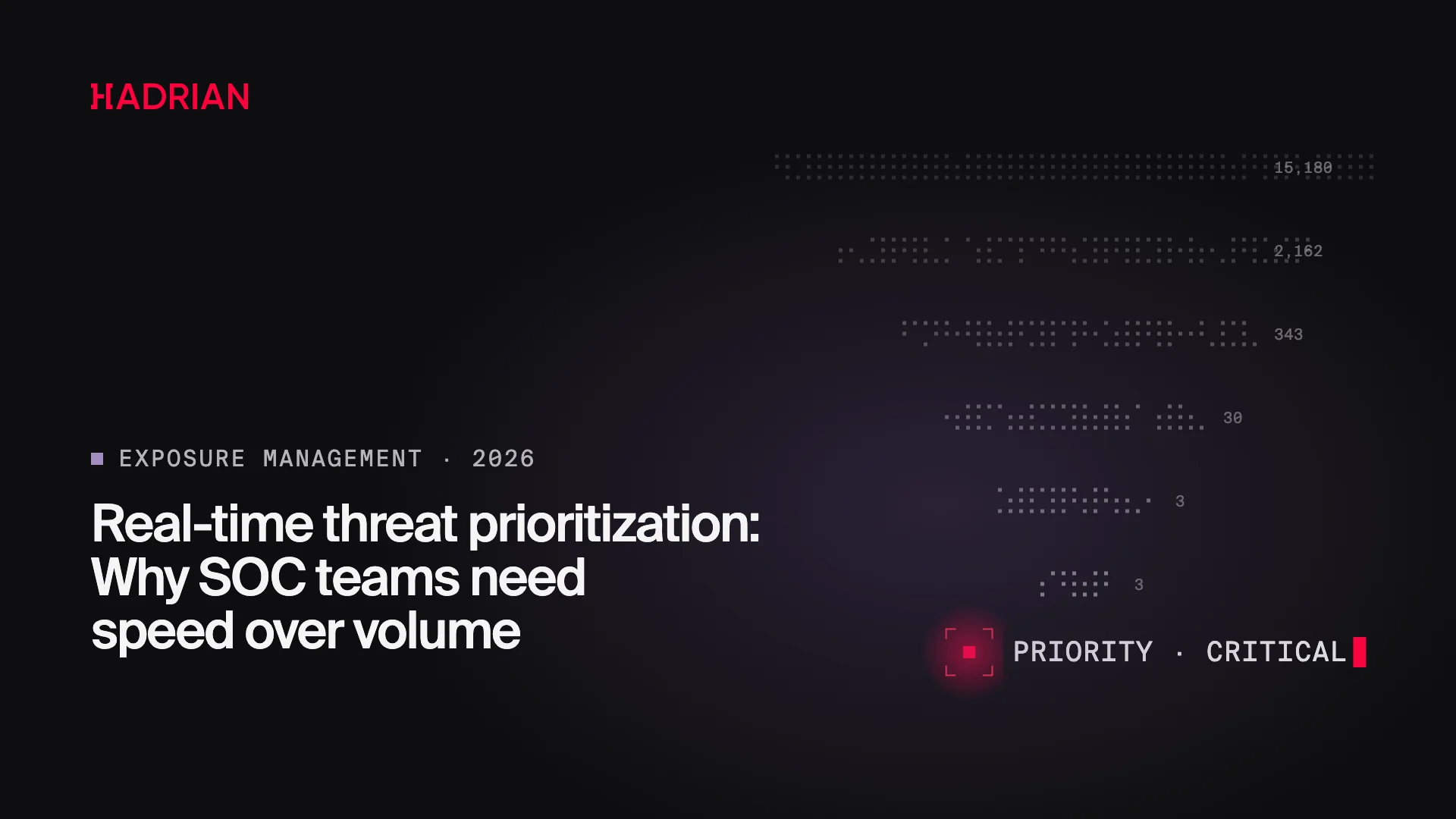
The result? SOC teams stop chasing ghosts and start hunting monsters. Only 0.47% of scanner findings are actually exploitable—real-time prioritization ensures you focus on that 0.47% rather than drowning in the other 99.53%.
What to look for in real-time threat prioritization solutions
When evaluating platforms for real-time threat prioritization capabilities, focus on these essential features:
Event-driven architecture: The platform should trigger assessments based on actual changes (new assets, new exploits, configuration changes) rather than running on fixed schedules. Look for solutions that can detect production deployment risks within 15-20 minutes.
Active exploitation validation: The solution must go beyond passive scanning to actively (but safely) simulate attack techniques, providing reproducible proof-of-concept that demonstrates exploitability and eliminates false positives.
Context-based scoring: Prioritization should evaluate asset criticality, business relevance, internet exposure, and compensating controls—not just rely on generic CVSS scores. The platform should adapt scoring based on your organization's specific environment.
Threat intelligence integration: Built-in integration with CISA KEV, APT tracking, dark web monitoring, and exploit databases ensures prioritization reflects the real-world threat landscape, not just theoretical severity.
Organizational customization: The ability to tag assets ("crown jewel," "production," "compliance-critical"), establish asset groups, and provide feedback that refines future scoring ensures the platform adapts to your specific risk tolerance.
Moving to continuous proactivity
The verification crisis isn't going away. The AI threat isn't slowing down. And 2026 won't be easier than 2025.
But for organizations that implement continuous, autonomous validation of their attack surfaces (the ones who solve the prioritization problem while everyone else drowns in alerts) 2026 will be the year they pull ahead.
Real-time threat prioritization transforms vulnerability management from a reactive compliance exercise into a proactive defense strategy. It ensures that when someone asks "what should we fix first?", you have a confident, data-driven answer backed by proof of exploitability, business context, and threat intelligence.
Ask yourself these questions:
- Can you name your top 10 exploitable exposures right now—not your highest CVSS scores, but the 10 vulnerabilities attackers would actually leverage?
- Do you have visibility into AI tools your developers are using and the endpoints they're creating?
- If a critical vulnerability were discovered today that isn't a "zero-day," how long would it realistically take to remediate?
- What percentage of your vulnerability findings have you validated as actually exploitable in your environment?
If you can't answer these confidently, you need real-time threat prioritization.
{{cta-demo}}