

Learn how Hadrian helps security teams find, verify, and fix what attackers actually exploit.

Plan
Transforming chaos into strategy with context
Focus and efficiency have never been easier
Hadrian's prioritization methodology is defined by its ability to validate risk through the hacker’s perspective, ensuring every prioritized exposure is both real and relevant to your unique environment.
Since no organization has unlimited resources, this stage is meant to make sense of the noise, ensuring your team focuses its efforts on the exposures that matter most based on your unique business structure and the nature of the threat.
Prioritization requires evaluating exploitability in YOUR environment; a high-severity vulnerability that is not actually exploitable due to compensating controls or system configuration is an unnecessary distraction for your team.
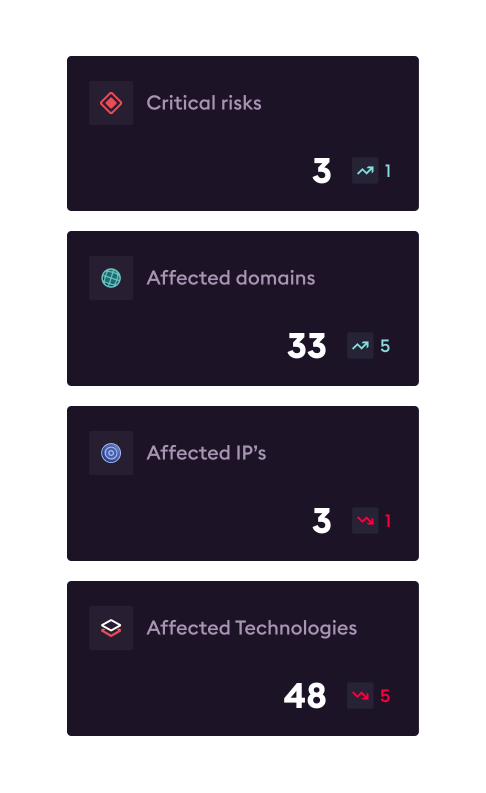
Know the blast radius and work to minimize impact
The Plan phase's ultimate goal is to minimize the potential impact of a successful breach. Hadrian achieves this by intelligently assessing where your attack surface contains choke points. By looking at the potential connections between systems, Hadrian can effectively identify if an asset with a low-severity vulnerability could turn into a big problem for you, depending on what critical systems it connects to.
If a breach could affect the integrity, confidentiality, or availability of business-critical systems, that exposure gets moved to the top of the list. The final priority ranking integrates factors like urgency (e.g., actively exploited vulnerabilities require immediate attention) and impact based on the potential consequences to the business. This methodology ensures your strategy focuses on the highest-value targets and provides the best return on security investment.
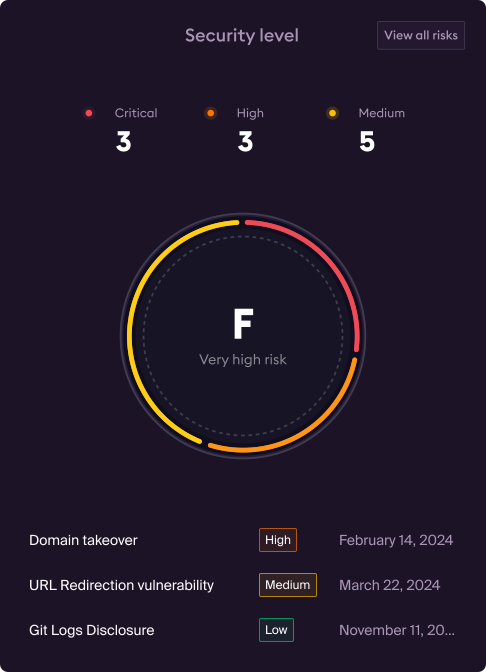
Goodbye boring scoring, hello strategy
Before an attack is simulated, the Plan phase is dedicated to building critical context around discovered assets. This process, often called Context Engineering, is how Hadrian transforms raw data into a strategic blueprint for risk.
Hadrian ensures effective resource allocation by employing a holistic scoring system that is enriched with threat intelligence and business context into the severity ranking.
- While standard severity scores are a necessary starting point, Hadrian enhances prioritization by including a multitude of factors like the age of the code, classification of the page, and other context engineering methods that give you the most accurate picture of exposure.
- The final priority ranking integrates factors like urgency (e.g., actively exploited vulnerabilities require immediate attention) and impact based on the potential consequences to the business.
Take the first step in the shoes of your adversary
Hadrian provides you with the hacker’s perspective on your internet-facing business to fortify your cybersecurity posture. Curious to know what they see?
Leading the pack
Hadrian is at the frontier of agentic AI-driven offensive security with recognition in Gartner® Market Guide for Adversarial Exposure Validation. Hadrian has also been recognized as a Leader in the GigaOm Radar Report for the second year in a row, and received Frost & Sullivan's New Product Innovation Award.

How does Hadrian prioritize risks?
Hadrian prioritizes risks using a proprietary, context-aware machine learning algorithm that goes beyond standard vulnerability scores (like CVSS). Instead of treating every vulnerability equally, the platform assesses the actual danger an asset faces based on "the hacker's perspective."
How does Hadrian distinguish 'Verified' from 'Potential' risks in prioritization?
Hadrian distinguishes between "Potential" and "Verified" risks by leveraging its AI Orchestrator to actively validate theoretical vulnerabilities rather than relying solely on passive detection. While Potential risks are identified through non-intrusive methods like version fingerprinting and represent hygiene issues or theoretical susceptibilities, Verified risks are confirmed threats where the AI has successfully simulated an ethical hack to prove exploitability. This validation process eliminates false positives by providing concrete Proof of Concept (PoC) evidence for every confirmed flaw, allowing security teams to filter out noise and prioritize immediate remediation for genuine, actionable threats over theoretical exposures.
How does user feedback refine the AI risk scoring model?
Hadrian refines its AI risk scoring model through a continuous feedback loop where user-driven adjustments to risk severity directly train the machine learning algorithms. When users manually re-categorize a risk based on internal context, the model learns to tailor future assessments, while Hadrian’s in-house hacker team simultaneously reviews these changes to validate algorithmic accuracy. Although analysis indicates that only a fraction of a percent of risks are typically re-categorized—suggesting high initial precision—this combination of automated learning and human oversight ensures the platform constantly evolves to match the specific security reality of each organization.
How do 'Verified Risks' help eliminate manual proof of work?
Hadrian’s "Verified Risks" eliminate the need for manual proof of work by leveraging an AI Orchestrator that autonomously validates vulnerabilities through safe, real-world attack simulations, effectively filtering out the false positives that plague traditional management. This process replaces time-consuming manual investigation with automated evidence generation, providing developers with detailed Proof of Concept (PoC) logs, attack chain descriptions, and specific remediation instructions. By further automating the lifecycle through instant regression testing to confirm successful fixes, Hadrian ensures that security teams can bypass the tedious validation phase and focus entirely on remediating genuine, confirmed threats.