Know where you stand

The gap between where your exposure programme is and where it needs to be is rarely about resources. Your organisation should be able to discover exposure, confirm it is real, and close it before an attacker can act. The maturity model tells you where your structure breaks down, and what fixing it looks like from where you are today.

Jump to...

Organisations that understand where their exposure programme stands advance faster, remediate more accurately, and make better investment decisions. Hadrian's Exposure Maturity Model gives you the language, the diagnostic, and the roadmap, so you know exactly where you are, what is holding you back, and what advancing looks like from here.

Faster remediation, less noise

Organisations that advance from Stage 1 to Stage 2 see mean remediation time drop from 90+ days toward 45. True-positive rates improve from under 10% to 15-25%. The security team stops spending most of its time on findings that turn out to be irrelevant.

The right investment in the right place

Knowing your maturity stage tells you where spend will move the needle and where it won't. Organisations that advance from Stage 2 to Stage 3 see SLA compliance rise from below 40% to 60-80% and MTTR compress to 15-45 days.

From days to hours

When a new exploit is disclosed, Stage 3 organisations take days to confirm exposure. Stage 4 organisations know within hours. MTTR falls below seven days overall, with critical exposures closed within 24.

Discover your maturity stage

Most programmes have one dimension that is suppressing everything else. Seven questions across five operational areas will tell you exactly where your programme stands and which specific bottleneck is holding it back. Results are immediate and specific to you.

Exposure Maturity Assessment

What does advancing actually deliver?

Stage
1

At Stage 1, your team finds out about exposure when something breaks. Ownership is unclear, findings pile up faster than anyone can validate them, and the board gets compliance reports instead of posture data. Advancing gives you a systematic picture for the first time.

Stage
2

At Stage 2, you have structure but not confidence. Coverage is improving but exploitability is still assumed, not confirmed. Quarterly testing cannot keep pace with daily environment changes. Advancing closes the gap between what you find and what you can actually act on.

Stage
3

At Stage 3, findings are validated before they reach your team. The remaining constraint is speed and scale: connecting individual findings into attack paths still requires manual effort. Advancing means your programme answers exploit disclosures in hours, not days.

Stage
4

At Stage 4, the structural constraints of every earlier stage are gone. Discovery is continuous, validation is autonomous, and leadership sees live posture data. The question is no longer what are we exposed to, it is how fast can we close it.

Case study

Damen Shipyards Group

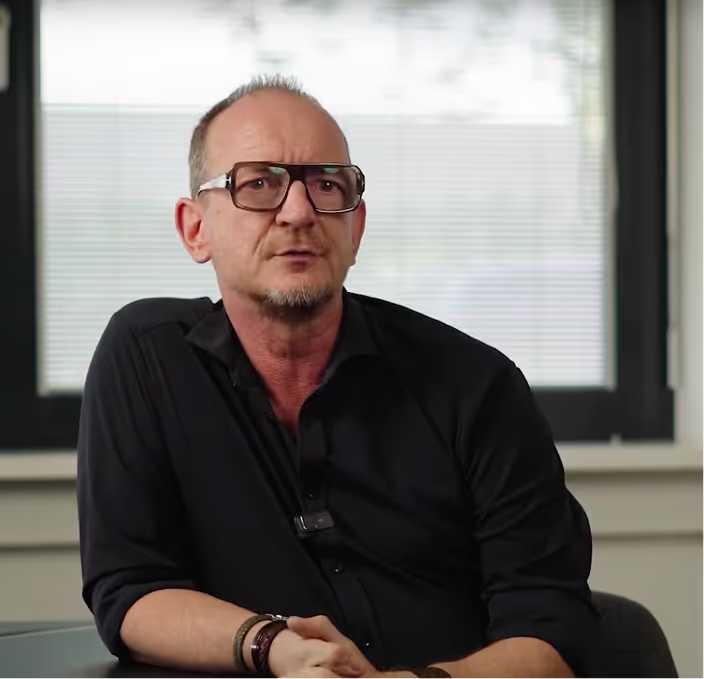
Securing its expanding attack surface with continuous validation

Ready to move to the next stage? 
Join us live

Webinar

Stage 1 to 2: Better Scope, More Hope

Webinar

Stage 2 to 3: Connecting the Dots

Webinar

Stage 3 to 4: Clear Picture