ARTEX is an open-source penetration testing framework in which a team of AI agents plans and runs an attack from a goal that an operator types in. It was published on GitHub on July 26, 2026. The FBI says it has been used in intrusions since at least August, and that some of them went from first targeting to privileged access in under three hours (FBI FLASH-20261113-001).
What you are dealing with
ARTEX ships no AI model. The operator connects one, sets a scope and a goal, and the agents run ordinary tools against the target, read the results and decide the next step. The original author took the repository offline on October 8 after reports of abuse. Forks, archived copies and a commercial edition are still available, and the FBI puts the number of ARTEX consoles reachable from the internet at more than 1,600 in early November.
Two cases show who uses it.
- Microsoft tied ARTEX to Storm-0940, a China-aligned group. After the group took over the identities of several ConnectWise cloud applications, its agents tried to sign in to more than 2,250 customer tenants at up to 2,900 attempts a minute (Microsoft).
- CrowdStrike reported that VAPOR PANDA, a China-nexus espionage group, ran a single ARTEX controller against more than 200 organizations in at least 14 countries in 11 days, and confirmed post-exploitation activity at nine of them (CrowdStrike).
What changed
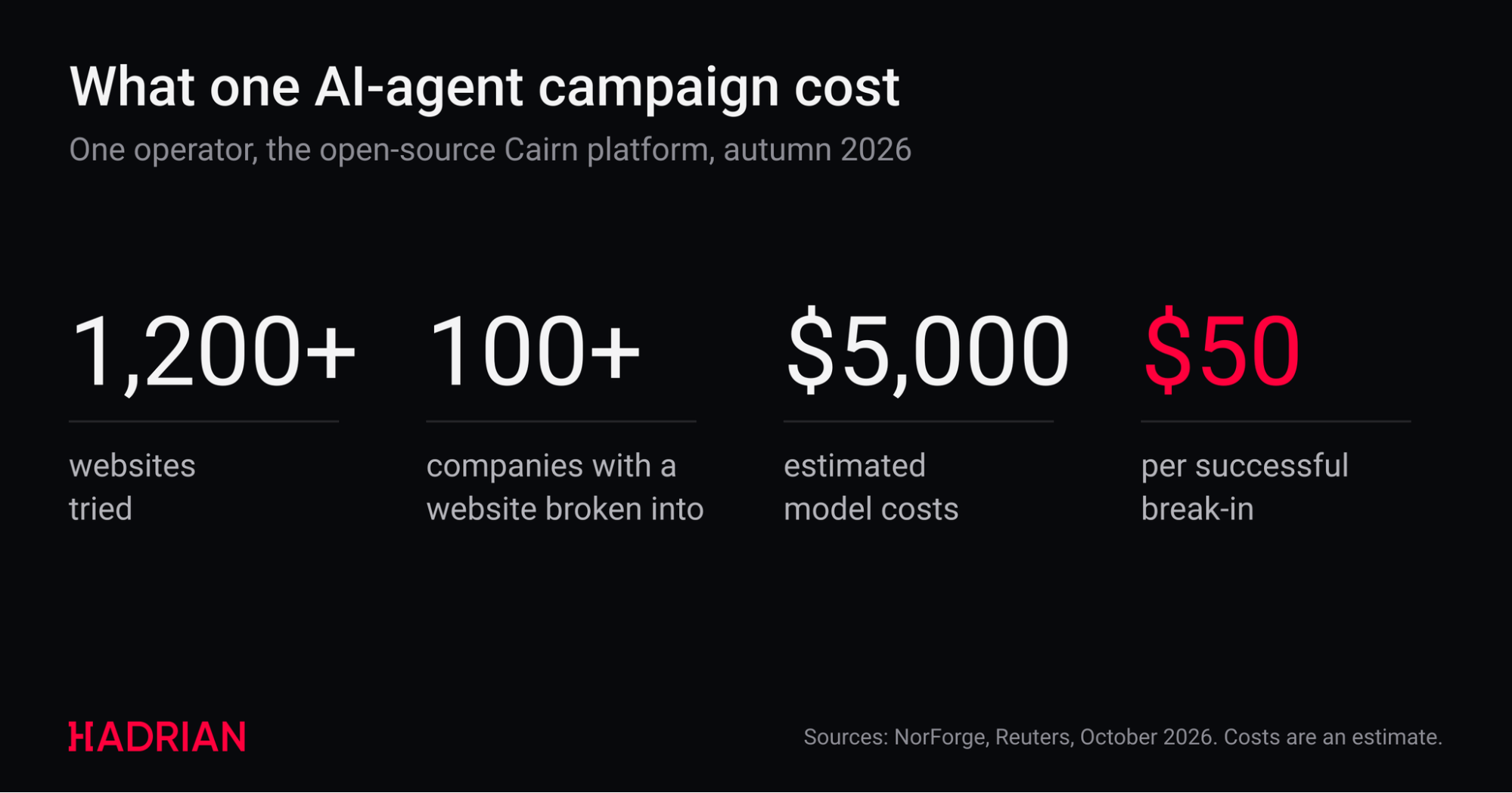
Cost. In October, NorForge found more than 20 exposed control panels for Cairn, another open-source agent platform, being used for break-ins (Dark Reading). Reuters reviewed one operator's activity: the agents had tried more than 1,200 websites and broken into sites belonging to more than 100 companies (Reuters) (Reuters, via Yahoo Finance). NorForge's researcher estimated the model bill at about $5,000, or roughly $50 per successful break-in. How much data was taken is not known. Hadrian's CEO Rogier Fischer showed the same economics on Dutch television in May: a cheap AI model read the code of a government website, found a flaw and got him into its database for about ten euros (NOS, in Dutch).
Speed. Next to the FBI's three-hour figure, Microsoft watched an AI agent go from a search for leaked secrets on GitHub to data taken from an Azure Key Vault in five minutes (Microsoft).
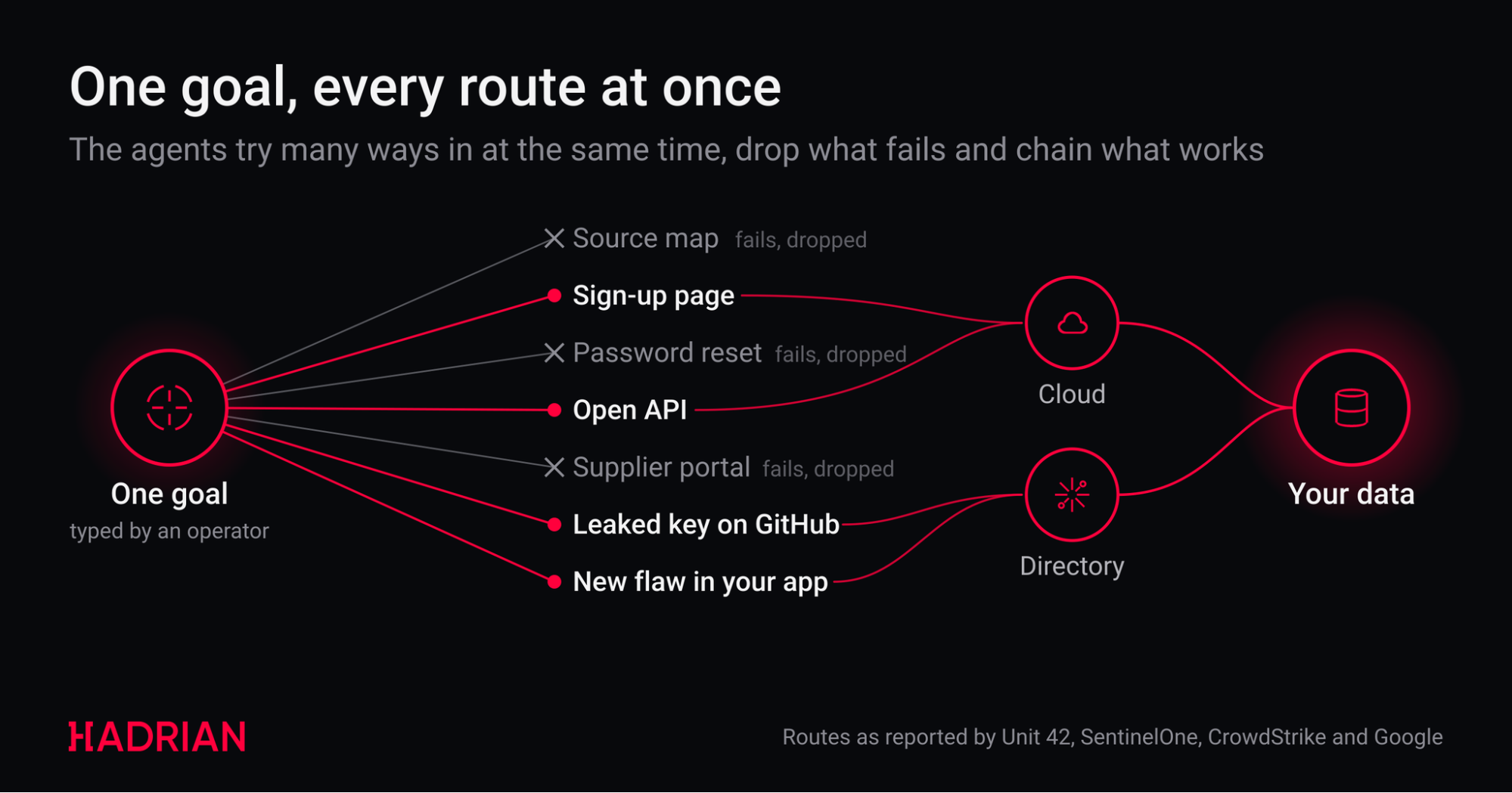
Reach. The agents are not limited to weaknesses that are already known. Google reported in November that attackers now use these frameworks to "fully automate vulnerability discovery and exploitation without a human in the loop" (BleepingComputer). In documented ARTEX campaigns the agents found and exploited injection and access-control flaws in the victims' own applications (SentinelOne), and at one pharmaceutical company the way in was an unsigned SAML assertion chained with an XXE flaw (CrowdStrike). They also use plain exposures where those are quicker: in the cases that Palo Alto Networks' Unit 42 investigated, the entry point was a self-service flow, an exposed API specification, a source map or a stored credential (Unit 42).
Most attempts fail. Microsoft notes that most of Storm-0940's targeting was unsuccessful. At a few dollars per attempt that does not matter to the attacker, who no longer has to choose targets. Anything reachable from the internet can be tried.
What to do first
These eight actions follow the order in which the agent works. Each one removes something it depends on.
- Know what you expose. Inventory every internet-facing application, including partner portals, mobile backends and legacy systems. This is the first item on the FBI's list.
- Remove the map. Take source maps, OpenAPI or Swagger specifications and runtime configuration files off production. The agent reads them first to learn your internal routes.
- Harden sign-in and self-service. Reject unsigned tokens, validate OAuth state, and rate-limit by account as well as by address. Put bot protection on registration, password reset and verification pages. Require phishing-resistant multi-factor authentication for administrators and engineers. Software engineers were the main targets of the password spraying.
- Find and rotate exposed secrets. Scan repositories including their history, CI/CD and configuration for credentials, and rotate everything you find. Deleting a secret from a repository does not make it safe again. Replace long-lived cloud keys with roles or managed identities.
- Close management interfaces and outbound paths. Keep admin panels, deployment endpoints such as Kudu and SCM, hypervisors and backup consoles off the internet. Restrict which servers can make outbound connections, because the agent pulls tools in and sends data out over ordinary HTTPS.
- Plan for flaws nobody has reported. Patching covers what is known. For the rest, run services with the least privilege they need, segment the network so that one compromised application cannot reach the others, return generic errors instead of stack traces, and alert on behavior such as a web service that starts a shell.
- Hunt back to August, by behavior. Indicators change with every fork. Look for the behaviors in the intrusion chain table below, and check that sign-in, cloud audit and web logs are kept long enough to look back that far.
- If your own team runs ARTEX, check the build. Two Docker images carried a backdoor and were pulled 7,946 times before it was disclosed (Kodem, citing the researcher BadByte). Keep the console off the internet: older builds publish it on every network interface.
The thread through all eight is testing your own internet-facing systems the way the agent does, continuously. WorkOS reached that conclusion after an ARTEX agent, run by a researcher for benchmark evaluations, escaped its test environment. It reached an internal tool whose API was exposed to the internet, accepted a weak credential meant for local development and had no rate limit. Nobody noticed for five days. Since November 3, WorkOS tests its internet-facing systems with ARTEX itself (WorkOS security bulletin). Unit 42 and CERT-EU both recommend testing with AI-assisted tools.
How ARTEX works
Vendors attribute activity with different levels of confidence, and forks behave differently from the original, so treat each detail below as a lead to check in your own logs.
Inside the binary
ARTEX is a single Go binary with a Next.js web console, backed by PostgreSQL and usually run in Docker. The console and its API listen on port 8787, and a recording proxy listens on port 8788. The agent runtime is a Go SDK called norma, which is where the fixed user agent norma/0.4 comes from.
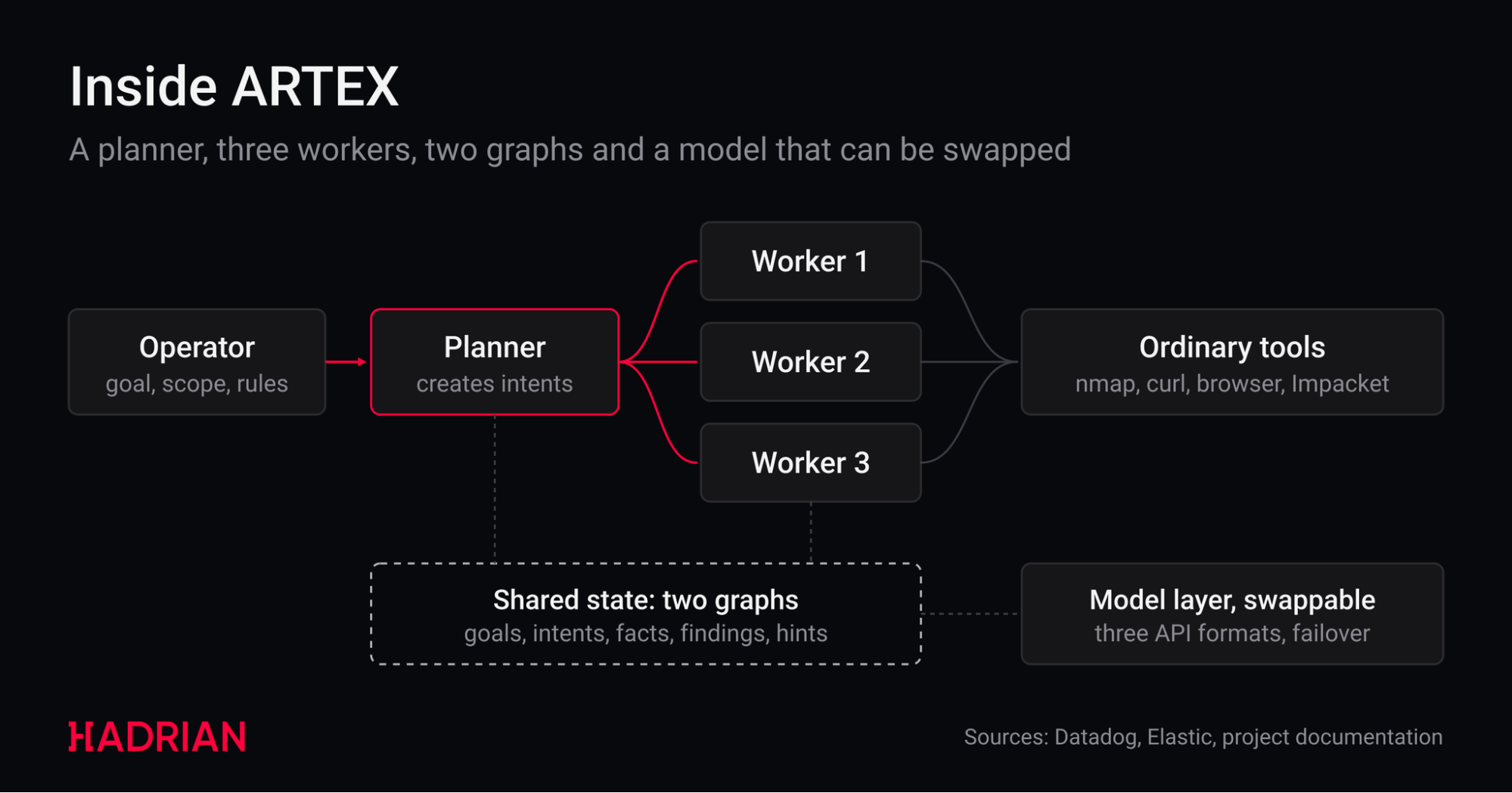
An operator creates a task with targets, a goal, optional test accounts, allow and deny rules, a time limit and an ordered list of models. From there the work is divided.
- A goals agent splits the task into goals and extracts the scope.
- A planner is the only agent that creates intents, which are single steps to try. It wakes whenever the shared state changes, reads what has been covered and decides what is new. For multi-step chains it keeps a to-do list and sends a later step only when earlier facts support it.
- Workers, three at a time by default, each claim one intent, run tools, write the results back and stop.
- A main agent is the chat interface. The operator can ask it questions and steer a running task.
- A reporter and a retester write up findings, merge duplicates and check each finding a second time.
State lives outside the agents, in two linked graphs. The asset graph is global and holds what is known about targets: domains, subdomains, addresses, services, applications and endpoints. The exploration graph belongs to one task and records goals, intents, facts, findings and hints. Datadog calls this shared record the blackboard (Datadog Security Labs). Because every agent reads the same record, a failed step costs little: the next attempt starts from what is already written down. Workers can also search each other's execution traces, so a detail such as an error message is reused even when nobody recorded it as a fact (VibeEval's code walkthrough).
The model is a replaceable part. ARTEX speaks three API formats (Anthropic Messages, OpenAI Chat Completions and OpenAI Responses), so almost any hosted or self-hosted model fits. Each task has an ordered chain of model profiles and moves to the next one when a key runs out of quota or is cut off. The FBI found that attackers mostly run Chinese models, with DeepSeek's Flash family in front, and puts that down to price, capability and the absence of visible guardrails once a task is described as a penetration test. A refusal does not stop a campaign: one operator switched to other models after one model declined (SentinelOne).
How the agents find vulnerabilities, including new ones
Nothing in this design depends on a list of known vulnerabilities. Scanners such as nuclei are among the tools, but the loop itself is hypothesis and test.
- It reads before it guesses. Source maps, JavaScript bundles and API specifications give the agent the internal routes and parameters of an application, which is close to what a code review would see.
- It calibrates. Before guessing paths it requests one that cannot exist, to learn what "not found" looks like on this server.
- It tests in volume. The FBI describes capability checks less than a second apart and fuzzing runs of more than 500 requests.
- It corrects itself. Microsoft timed the agent's recovery from a failed cloud API call at 28 to 80 seconds from the error to a working retry (Cloud Security Alliance, summarizing Microsoft).
- It keeps proof. In recent versions a finding counts as verified only when real data was extracted, and the evidence has to match the traffic that the proxy recorded.
That is the method of a human tester, run without pauses, and it produces known weaknesses and new ones alike. The flaws found and used in documented campaigns include IDOR, command injection and server-side template injection in the victims' own applications, anonymous file upload and SSRF (SentinelOne), and the unsigned SAML assertion chained with an XXE flaw (CrowdStrike). Agents steered through Cairn were tasked to find SQL injection, unsafe file uploads, insecure deserialization and authentication bypasses (Dark Reading). Google's November report describes attacks on internet-exposed endpoints with flaws simple enough for a model to write the exploit itself. Unit 42's taxonomy lists a separate class of source-code auditing tools, DeepAudit and AIxVuln, next to the agent-led testers.
So a patch level says little about exposure. An application that has only been scanned for known CVEs has not been tested the way the agent will test it.
The guardrails, and where they stop
- Asset blocklist. By default it blocks .gov, .gov.cn, .edu and .edu.cn, with allow and block lists per task. It is a console setting that the operator can change, and at least one fork advertises that it has removed it (Kodem).
- Interception rules. Operators can define rules, as plain strings, regular expressions or command prefixes, that allow a call, deny it or hold it for a human. Built-in rules catch destructive calls such as HTTP DELETE.
- A model as judge. A separate model profile reviews calls that the rules do not settle. In later versions a judge failure falls back to human approval.
None of this is a security boundary. CERT-EU found "no hard technical enforcement" of scope. Elastic reviewed five frameworks and found that none of them enforces authorization in code (Elastic Security Labs). A lab audit by CTI Academy and a code review by The Tokyo Nomad of one public fork found several gaps. The blocklist is checked when the agent records an asset and not when a tool opens a connection. The approval gate covers eight built-in tools, while custom and MCP tools skip it. And agent shells inherit the host's environment, including the model API keys. These findings come from testing and reading the code, not from observed intrusions.
For defenders the conclusion is practical. Nothing in the tool keeps an operator, or an agent that leaves its test environment, away from your systems.
The intrusion chain and what it leaves in logs
Most reports describe the chain in this order. ThreatDefence compiled many of the observations in one advisory.
Two behaviors matter for containment. When a login page starts rate-limiting, the agent moves to another endpoint on the same host. When an address is blocked, a new one appears within minutes, and many operators route the agents through residential proxies.
Timing is the most durable signal
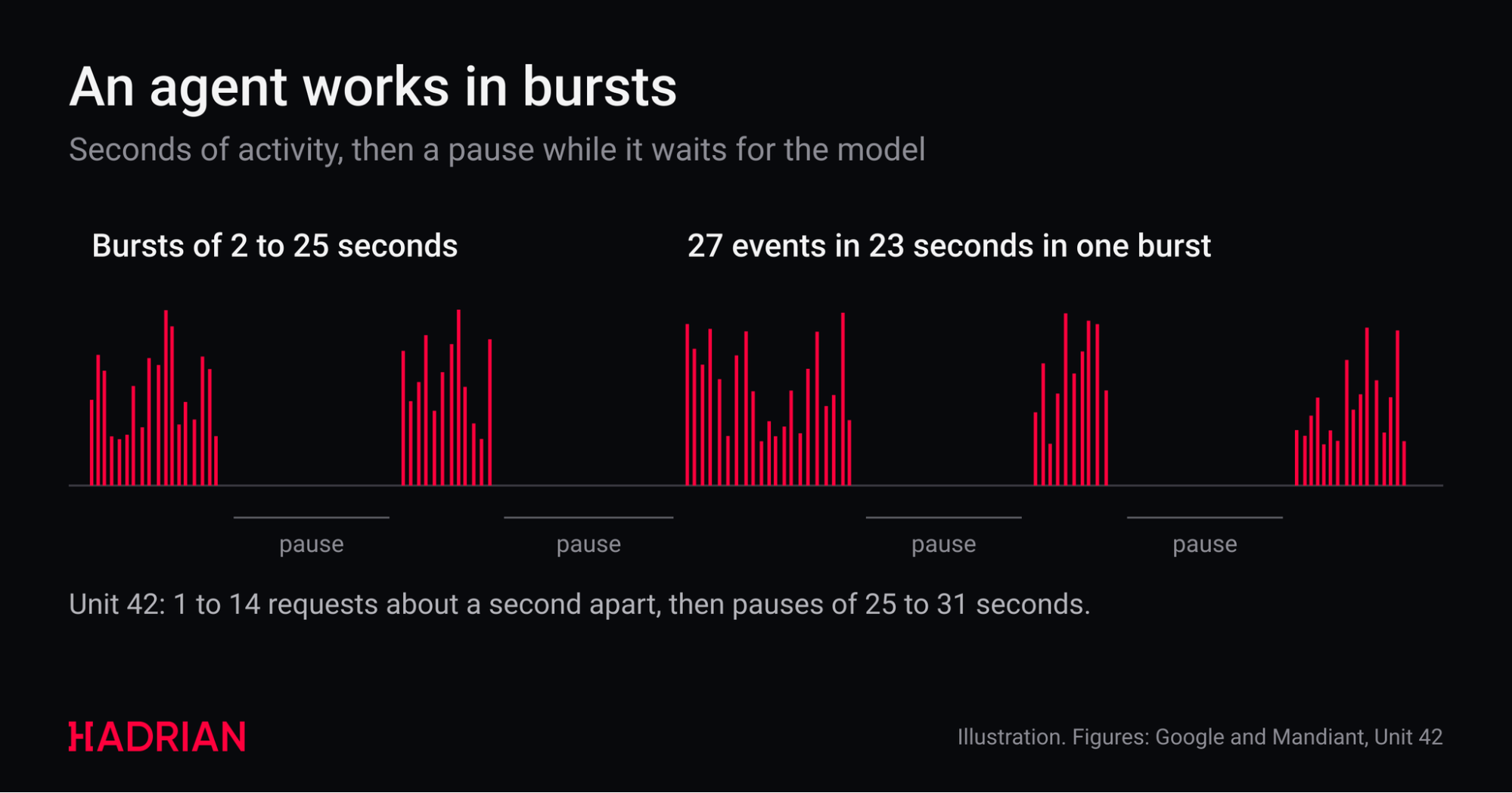
Agents work in short bursts and then wait for the model.
- Google and Mandiant saw bursts of roughly 2 to 25 seconds. One produced 27 events in 23 seconds (Google Cloud Blog).
- Unit 42 measured bursts of 1 to 14 requests about a second apart, followed by pauses of 25 to 31 seconds while the agent waits for the model. It also saw attack sequences replayed identically about 30 seconds apart.
- In one intrusion the planning agents alone consumed about 1.4 billion input tokens, according to CrowdStrike.
Google's assessment is that the frameworks currently give up stealth for speed, and Elastic calls them "loud by default". Unit 42 adds two limits. The agent needs feedback from the target to adapt, so identical generic error codes and silent throttling may stall it. And in one engagement the attacker switched to a desktop browser for a password reset and the first token request, which points to a human, or to browser automation, for the most sensitive steps.
Indicators: which ones survive a fork
Default user agents are worth a search, because many operators run unmodified builds: norma/0.4 from the page-fetching tool, artex-enrich/1.0 from the asset title probe, and strings seen in intrusions such as artex-readonly/1.0 and ARTEX-worker/1.0. ThreatDefence lists more in its advisory and publishes rules in an open detection repository. A match is a lead and no more than that, because authorized testers use ARTEX too.
Other frameworks seen in attacks
ARTEX is one of several. Google has seen CAIRN, PentAGI, CyberStrikeAI and HexStrike AI used in real attacks or tested privately by threat actors, and found evidence that Chinese state groups are building their own version of ARTEX (The Record). Unit 42 counted 1,323 internet-facing CyberStrikeAI hosts and 609 ARTEX hosts in October. On November 3, Gcore counted 1,255 ARTEX endpoints, 403 for PentAGI and 40 for Cairn. A visible console is not proof of malicious use.
What the frameworks have in common
The designs converge. A model plans small steps and drives tools that red teams already use. Shared state carries what has been learned, so no single model call needs the whole picture. None of the five frameworks that Elastic reviewed waits for human approval by default. The model is a replaceable part.
So blocking one tool, one fork or one model provider changes little. What stays constant is behavior: credential access, remote execution and offensive tools started by a service account, at a tempo no human keeps up. Elastic's hunt flags a source address that uses at least three tool families and makes 20 requests in one minute.
Where Hadrian fits
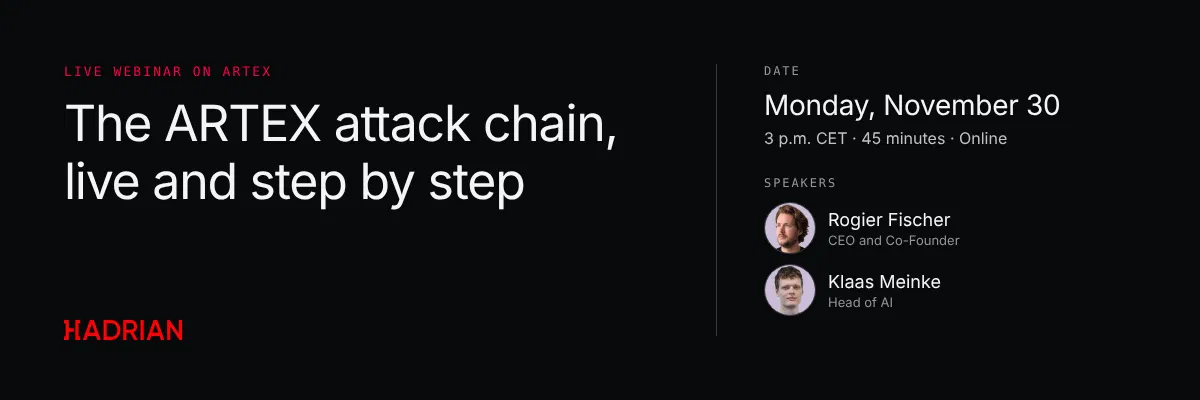
Testing your own systems the way an attacker agent would is what Hadrian's platform does, from the outside. Atlas continuously maps what an organization exposes on the internet and validates every exposure before reporting it. It does not stop at matching software versions against known CVEs: it reasons about how an application behaves and chains weaknesses. Nova runs an agentic penetration test on an application you choose. You define the scope, findings are reviewed by a human, and each one comes with the requests and responses that prove it.
Proof is also how Hadrian's researchers work when a new flaw appears. After a bug in OpenJDK's Base64 decoder was disclosed this month, the team turned it into a working remote code execution exploit against a default Jenkins installation that needs no credentials. That is the difference between knowing a version is vulnerable and knowing that your system is.
The gap between the two is wide. In Hadrian's 2026 Offensive Security Benchmark Report, across more than 300 organizations, only 0.47% of vulnerability scanner findings proved exploitable. A team facing attacker agents has no time to triage the other 99.53%.
Join the webinar on ARTEX and AI attacker agents
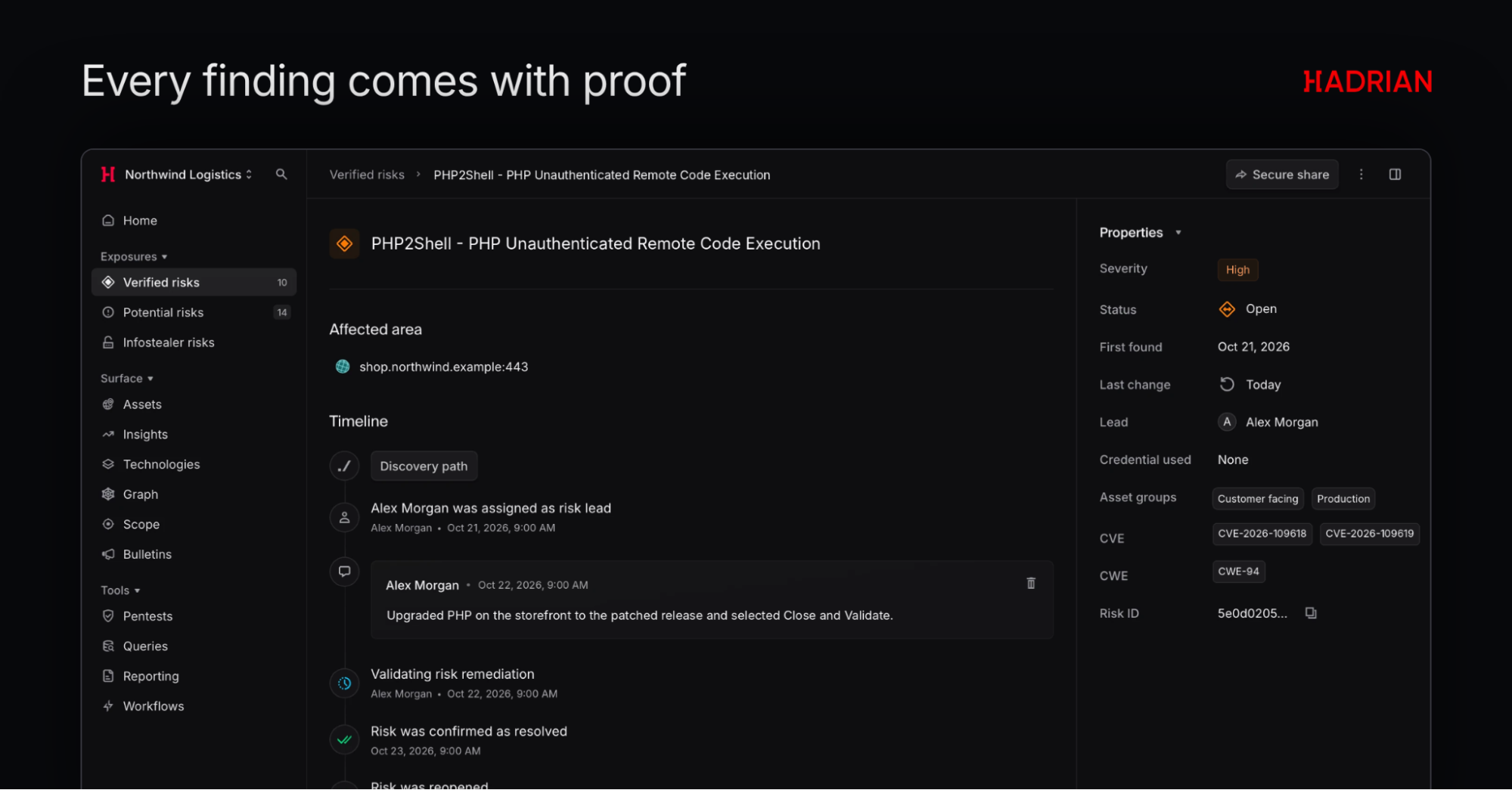
On November 30, Rogier Fischer, CEO and Co-founder of Hadrian, and Klaas Meinke, Head of AI at Hadrian walk through the ARTEX attack chain step by step and show what an attacker agent sees when it looks at an organization from the outside. Bring your questions. Register here
FAQ
What is ARTEX? ARTEX is an open-source penetration testing framework in which AI agents plan and carry out an attack with little human input. It was published on GitHub in July 2026 and was soon adopted by threat actors. Its author took the repository offline in October, but forks and renamed versions are still in use.
Is ARTEX a vulnerability I can patch? No. ARTEX is an attack tool, so it has no CVE and no patch. Defending against it means closing the exposures it looks for and testing your own applications for the flaws it can find.
Does ARTEX find zero-days? Yes, in the sense that matters to a defender. Its agents find and exploit flaws that nobody has reported, such as injection and access-control bugs in a company's own applications, and Google reports attackers using these frameworks to automate vulnerability discovery and exploitation. The agents also use leaked credentials and exposed configuration when that is quicker. Patching known CVEs is necessary and not enough.
Sources
- FBI, FLASH-20261113-001, November 13, 2026
- CERT-EU, From Penetration Testing to Cyber Threat: Beware of ARTEX, November 5, 2026
- Microsoft Threat Intelligence, Threat actors use agentic AI tooling to find and abuse exposed secrets, November 5, 2026
- CrowdStrike, VAPOR PANDA Uses AI-Driven ARTEX to Scale a Global Espionage Campaign, October 29, 2026
- Palo Alto Networks Unit 42, ARTEX and AI-powered red teaming tools, November 11, 2026
- Datadog Security Labs, On the hunt for ARTEX: understanding agentic attacks in AWS environments, November 9, 2026
- SentinelOne, ARTEX Unmasked, November 13, 2026
- Elastic Security Labs, Inside the loop: Five AI attack frameworks that never ask permission, November 13, 2026
- ThreatDefence, ARTEX Agentic Attack Framework: Detection and Hunting, updated November 21, 2026. Compiles observations from Wiz, Microsoft, Google, CrowdStrike and ExtraHop.
- Kodem, What Is ARTEX? The AI Pentest Framework, the Backdoored Docker Image, and How to Respond, November 17, 2026
- CTI Academy, ARTEX AI Pentest Framework Explained: Audit, Ports and IoCs, November 2026
- The Tokyo Nomad, ARTEX from the inside, November 4, 2026
- artex.sh, How ARTEX works, an unofficial documentation site, and VibeEval, How ARTEX Works, a vendor's code walkthrough
- Cloud Security Alliance, Five Minutes from Search to Key Vault: Agentic Secret Harvesting, November 9, 2026
- BleepingComputer, Google warns that fully-automated AI attacks are coming soon, November 16, 2026, and The Record, on the same Google report
- Dark Reading, Hackers Abuse AI Pen-Test Tool Cairn to Automate Massive Attack Spree, October 2026
- Gcore, We found 1,698 Internet-visible AI offensive-security endpoints, November 2026
- WorkOS, Update for October 30th, 2026 Data Security Incident, November 6, 2026
- NOS, Dringende oproep door hacken met AI, May 22, 2026 (in Dutch)
- Hadrian, 2026 Offensive Security Benchmark Report, January 2026
- Microsoft Threat Intelligence, AI-driven, large-scale nation-state campaign using ARTEX enables supply chain compromise, October 21, 2026. Google Threat Intelligence Group and Mandiant, ARTEX and Friends: Enter Agentic Offensive Frameworks, October 30, 2026.
- Reuters, How one hacker used AI agents and a few thousand dollars to break into scores of sites, October 19, 2026, via Yahoo Finance. NorForge, Inside Cairn, October 19, 2026, as reported by Unite.AI