Agentic pentesting is often described as a new way to test applications. That is true, although it misses the operational change that makes the approach useful in a real environment: an agent needs to know what exists, what has changed, and what is worth its attention before it can begin to test.
An external attack surface is not a stable list of domains maintained for an annual engagement. New cloud services appear, development teams expose APIs, acquisitions add infrastructure, and routine configuration changes alter what is reachable from the internet. A pentest that begins with an out-of-date inventory starts with an assumption attackers do not share. They begin with whatever they can find.
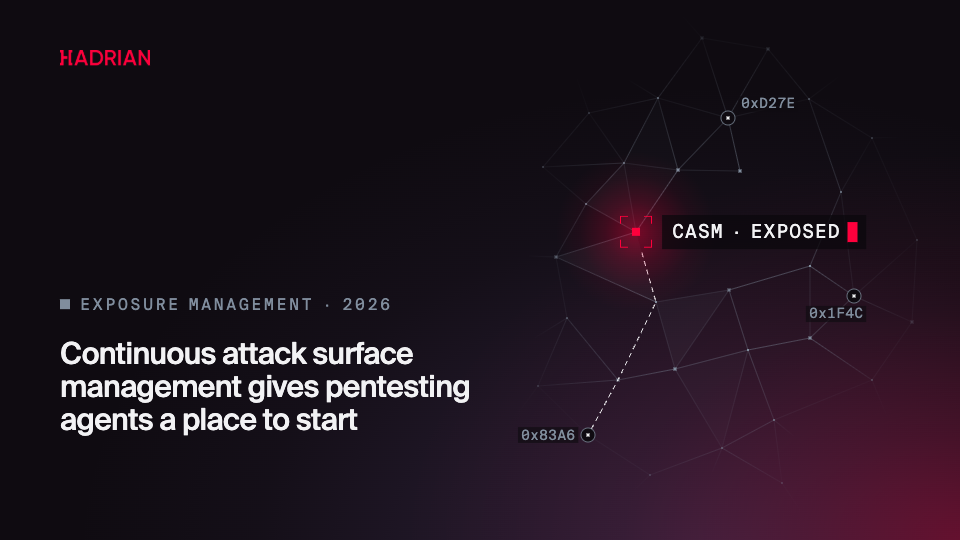
Continuous attack surface management gives a security team, and the agents working on its behalf, a current outside-in view of the organization. It turns the first stage of pentesting from a slow, manual reconstruction of the target into an informed investigation that can follow changes as they happen. That matters as the AI offensive security ecosystem expands, making reconnaissance and exploitation workflows easier for attackers to operationalize.
Every pentest begins with discovery
Before a human tester sends a payload or opens a browser, they build a picture of the target. They identify domains and IP addresses, connect related assets, learn which technologies are exposed, note likely entry points, and look for recent changes that might have created a new route in. This work is essential, yet it is often repeated from scratch because a conventional engagement is scoped as a point-in-time exercise.
The administrative process reinforces that cadence. Authorizing a pentest commonly takes six to twelve weeks, which is one reason many organizations test only once or twice a year. By the time a team has agreed scope, provided access, and scheduled the engagement, the external surface may have moved again.
Continuous attack surface management keeps the discovery work alive between tests. It maintains an external asset inventory, tracks exposed services and technologies, and connects new observations to information the team already holds. The result is more than a better list of assets. It gives a pentest a reasoned starting point.
Context determines what to test
An agentic pentest should not treat every reachable endpoint as equally important. A newly exposed marketing subdomain, an internet-facing administrative interface, and an API added to a customer workflow all require different questions. The context around each asset shapes the hypothesis a capable tester will pursue.
Consider a company that launches a new customer portal. Continuous discovery identifies the hostname, its relationship to the wider corporate domain, the application framework, its authentication provider, and the APIs the browser calls. It may also show that the portal appeared after the organization’s last test, or that its technology stack has a newly relevant CVE. Those observations do not prove an exposure, and reporting them as though they do would only create more work for the receiving team. They do, however, tell the testing system where to look and what it needs to establish.
That is a material difference from starting with a generic scan. The agent can investigate the portal’s actual authentication flow, map the endpoints that handle account and payment data, and test whether the business rules that the interface presents are genuinely enforced by the server. If the portal is outside the agreed scope, the same context makes the boundary visible before a request is ever sent.
A live attack surface makes testing more selective
The promise of agentic pentesting is not that every system should receive the same level of investigation at every moment. It is that testing can respond to the events that change risk.
When a previously unseen asset becomes public, when a critical technology is detected on an exposed service, or when a customer-facing application changes, an agentic system has a clear reason to revisit that part of the surface. It can begin with the external facts already available, set a bounded test objective, and build evidence around the result. The same approach helps with retesting. A remediation ticket marked complete does not necessarily establish that the exposure has been removed from the internet. A focused follow-up test can answer that question directly.
This is how continuous attack surface management moves beyond visibility. Asset data, technology fingerprints, known exposures, and historical test results become the context for deciding which actions deserve scarce security attention. Proof-backed findings then distinguish the issues that have been demonstrated from the signals that still need investigation.
Agents need to follow the target
The best pentests do not follow a rigid script from start to finish. A tester begins with broad reconnaissance, then changes course when they find an endpoint that deserves deeper work, an unusual authentication pattern, or a route that connects several small observations into a plausible attack path. Agentic pentesting can make that style of work repeatable across a broader external surface, provided it is working from current context and is constrained by clear permissions. As we have explored in A frontier AI model is not a pentest, the model’s ability to reason is only one part of a useful offensive security system.
For example, an agent might identify an exposed GraphQL endpoint from the application’s own requests, examine its schema, and focus its testing on the relationships it reveals. A separate agent may investigate whether two authorized test users can access each other’s resources. When evidence suggests a genuine cross-tenant issue, the system needs to reproduce the outcome with synthetic records and preserve the exact path it took. An unexpected status code or a plausible-looking response is only a lead, not a finding.
The discovery layer makes this work more efficient because it reduces blind exploration. It also makes the work more accountable. Teams can see why an agent was directed to a specific target, what change or exposure informed that choice, and what it attempted within the agreed scope.
Continuous testing requires continuous control
A system that can start testing when the attack surface changes must also remain safe when it acts. Current context is useful only when it is combined with controls that enforce scope, rate limits, tool restrictions, and safe handling of authenticated access. An agent should never infer that a newly discovered asset is authorized for testing simply because it appears related to the company.
This is where the relationship between attack surface management and agentic pentesting becomes practical. The attack-surface layer identifies and enriches the potential target. The testing layer assesses it within an approved boundary. Human experts define that boundary, decide when a finding matters to the business, and own remediation. The work in the middle can run continuously without turning every network change into an unbounded autonomous action.
Traditional pentesting still has an important role, particularly where an organization needs a formal attestation, deep review of complex business logic, or an engagement designed around a specific high-value scenario. Continuous, agentic testing addresses a different operational problem: keeping an outside-in view of the surface current enough that the organization can investigate and retest at the pace its environment changes.
The buyer question is whether the system has context
When evaluating AI-powered pentesting, buyers should look beyond the model and ask how the system determines where to begin. Does it inherit a current view of externally reachable assets, technologies, changes, and known exposure context? Can it explain why a particular service was selected for testing? Does it record the evidence for every finding, and can it retest after a fix or a material change?
Those questions expose the difference between a capable agent pointed at a URL and a continuous security capability that follows the real attack surface. Continuous attack surface management gives agents a place to start. Agentic pentesting gives the security team a way to turn that context into evidence about what an attacker can actually do.
For a practical evaluation framework, read What to look for in AI-powered pentesting.