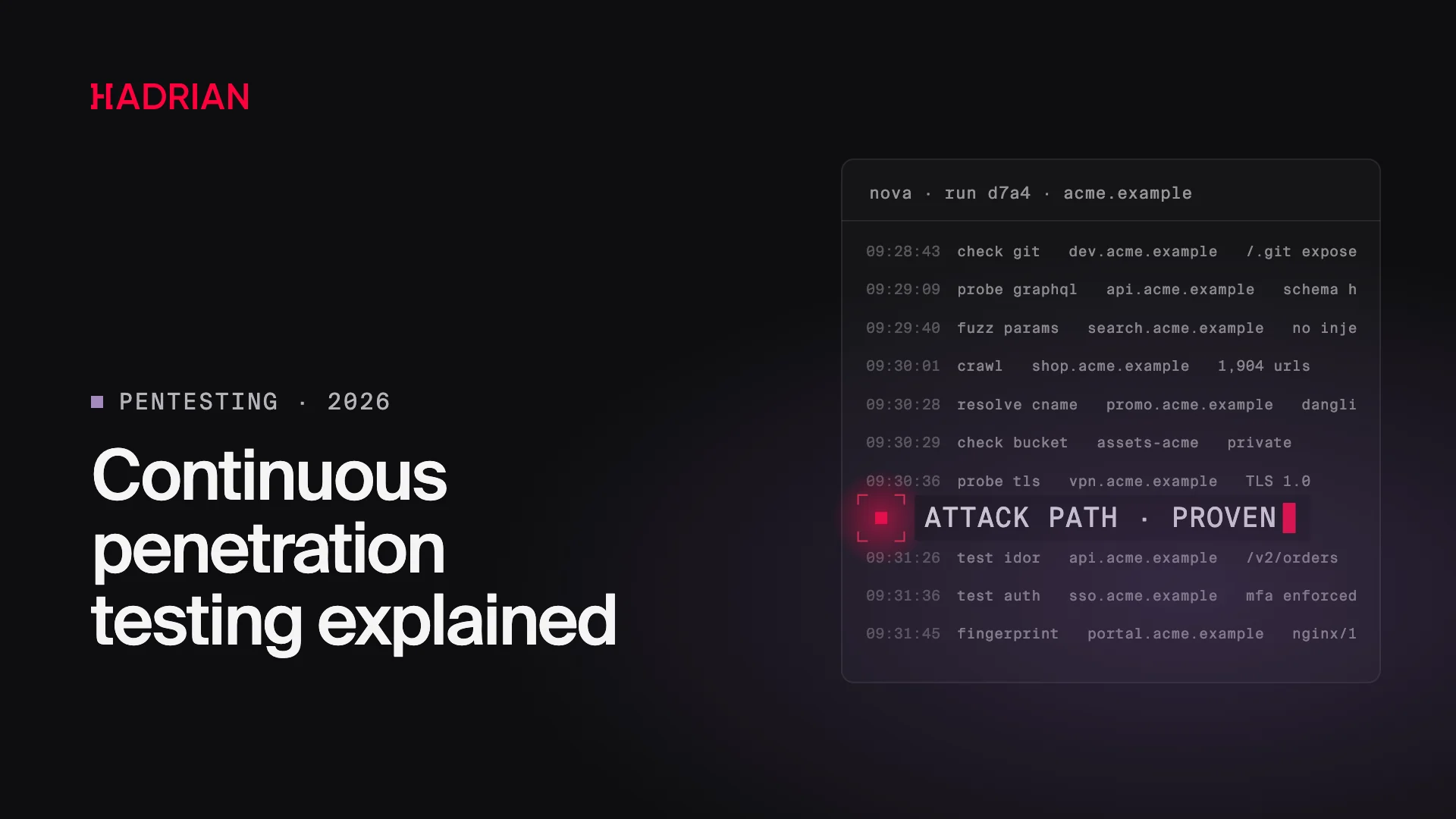
Continuous penetration testing is an ongoing program that tests your attack surface as it changes, rather than concentrating all testing into a single annual engagement. Tests run on regular cycles or are triggered by changes to your systems, so exposures are found within days instead of sitting undetected until the next scheduled test.
What is continuous penetration testing?
Continuous penetration testing applies the core principle of a pentest, actively trying to exploit weaknesses to prove real risk, as a recurring, change-driven process rather than a one-time assessment. Instead of a single snapshot followed by months of blind spots, testing runs on an ongoing basis and reacts to changes in the environment as they happen.
The practice exists because most systems now change constantly. A conventional test produces results that are accurate only for the moment it was run, while cloud resources, code, and configurations shift every week. Continuous penetration testing is designed to keep pace with that change.
Continuous vs point-in-time penetration testing: what's the difference?
A point-in-time penetration test is a deep assessment of a fixed scope over a set window, usually once or twice a year. Continuous penetration testing spreads testing across the year and reacts to change, trading a single deep snapshot for ongoing coverage that stays current.
Neither is the best approach; they solve different problems. The strongest programs combine them, using continuous testing for freshness and breadth and reserving periodic deep engagements for the systems that need the most scrutiny.
Why does the exposure window matter?
The exposure window is the time a weakness sits open before anyone finds and remediates it. With annual testing, that window can stretch to nearly a year: every deployment and configuration change between tests could introduce an exposure that stays undetected until the next test, or until an attacker finds it first.
Verizon's 2025 Data Breach Investigations Report found that exploitation of vulnerabilities as an initial access step rose 34% in a single year, and that the exploitation of internet-facing edge devices and virtual private networks (VPNs) grew nearly eightfold, from 3% to 22% of vulnerability-based breaches. The months between annual tests are exactly when adversaries are moving fastest. Continuous testing shrinks that window from months to days or weeks.
How does continuous penetration testing work?
Continuous penetration testing runs on regular cycles or is triggered by events, such as a code deployment or an infrastructure change, so newly introduced exposures are tested as they appear. Findings are reported as they are discovered rather than accumulated into a single annual document.
Making this work at enterprise scale depends on automation, and increasingly on agentic AI, because running real attacker techniques around the clock is not something a human team can sustain. Modern automated penetration testing tools attempt exploitation to confirm which exposures are genuinely reachable, which keeps the ongoing stream of findings focused on real risk rather than noise. Our automated penetration testing hub covers the mechanics in more depth.
When should you use continuous penetration testing?
Continuous penetration testing pays off when the speed of change in your environment has outpaced the speed of human testing. That describes most enterprises with large external attack surfaces, frequent deployments, recent acquisitions, or sensitive data. A small, stable application or a pure compliance requirement can still be served well by periodic testing.
It also fits the direction of exposure management as a whole. Continuous testing is effectively the validation engine of a continuous threat exposure management program, confirming on an ongoing basis which exposures an attacker could actually use. Our guide to continuous threat exposure management shows where it fits in the wider cycle.